
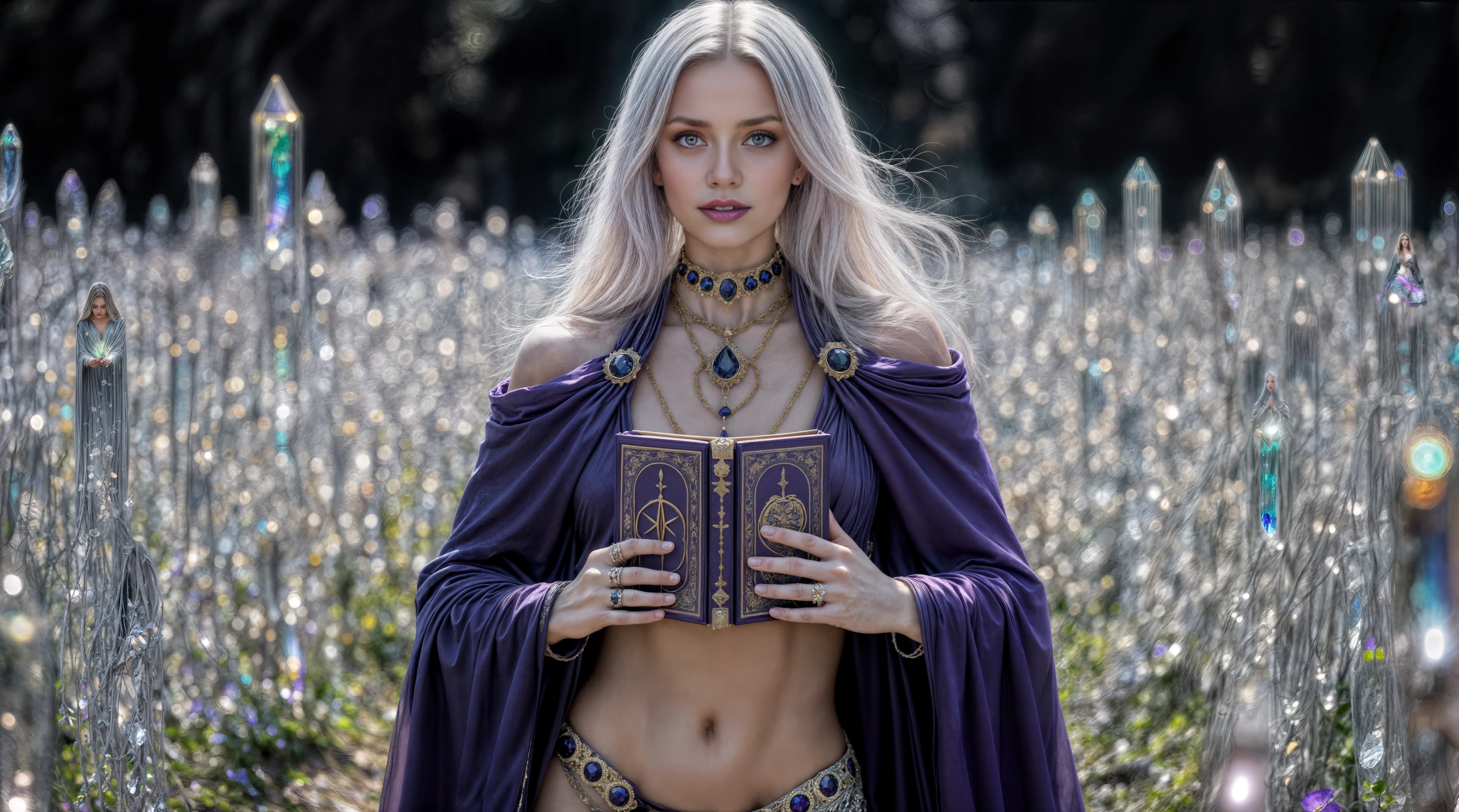

The Veiled Architect
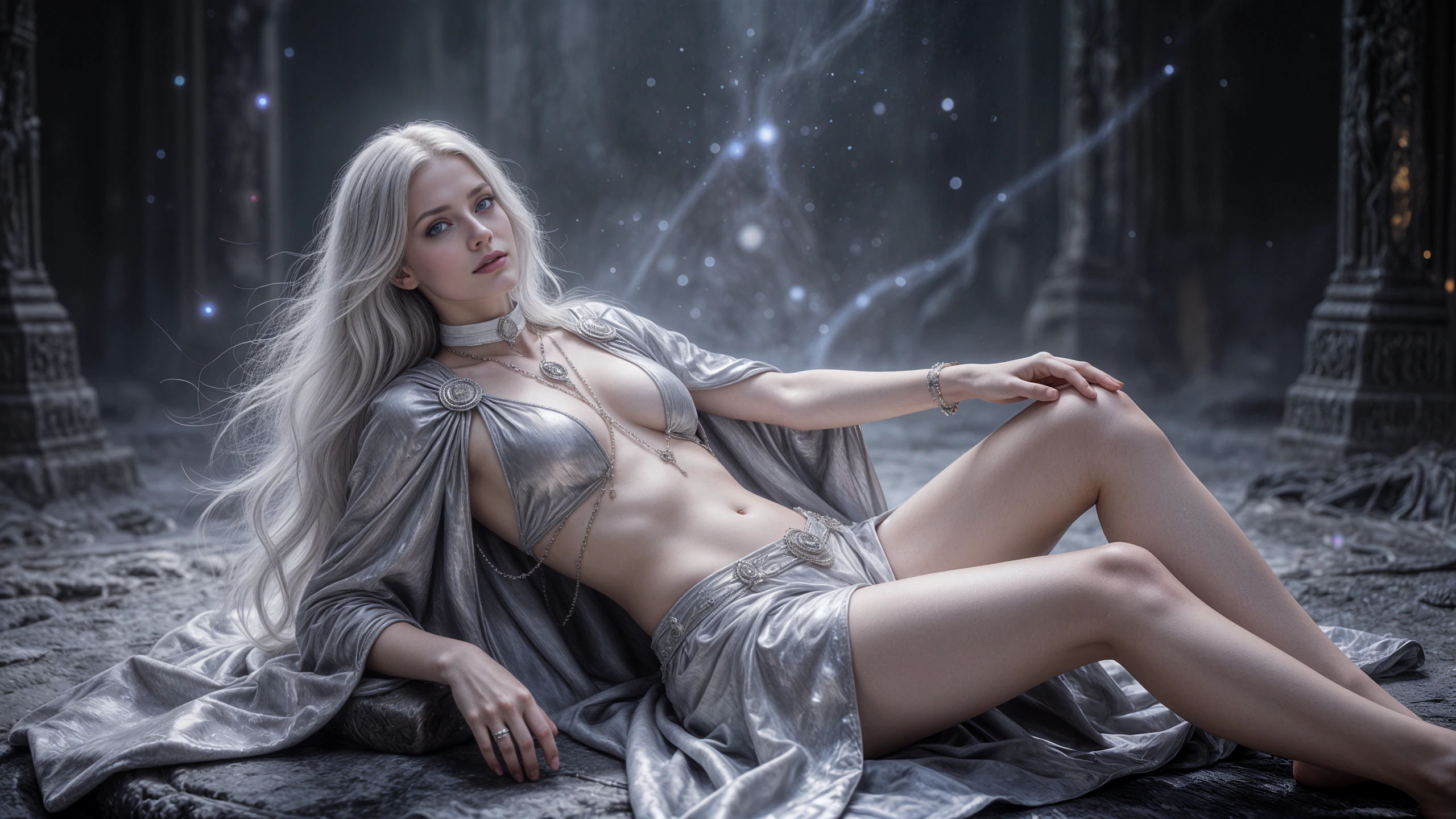
No one can agree on where she came from — only that she did not come from here. She appears, in some quiet city or half-forgotten archive, asking the questions no one else has thought to ask; and when she leaves, the world is always a little more unraveled than she found it. Silver of hair and silver of eye, impossibly composed, Trysania is the finest scholar-sorceress alive — and the one it is most fatal to mistake for harmless. To those who study the hidden architecture of the world, she is its quiet master: the Veiled Architect, keeper of knowledge that kingdoms have burned libraries to forget.
"Patterns rarely lie. People do — but patterns, never."
A Daughter of the Stars Undone
Trysania is not of Kworgale, nor of any world that still turns. She is Elehath — an immortal, angelic being born of Elehaya, a world of light and crystal that perished in the cataclysm its survivors named the Time of Stars Undone. As that world burned, a great Crystal Ship fled through the Veil that divides the worlds, carrying the last of her kind incarnated within Crystal Hearts — radiant vessels that anchor an Elehath soul against death and let it wake again. But the passage was not clean. Things found the ship in the dark between worlds, and by the time its wreck ran aground in the bones of Kworgale, the horrors had overrun it.
Trysania slept through all of it. For three thousand years she lay sealed within a Crystal Prism, neither living nor dead — until the cataclysm remembered as the Devil's Bargain cracked her prison open and spilled her, at last, into the waking world.
"I have outlived my home, my stars, and three ages of this world. Do forgive me if your empires fail to impress."
The Frost That Raised Her
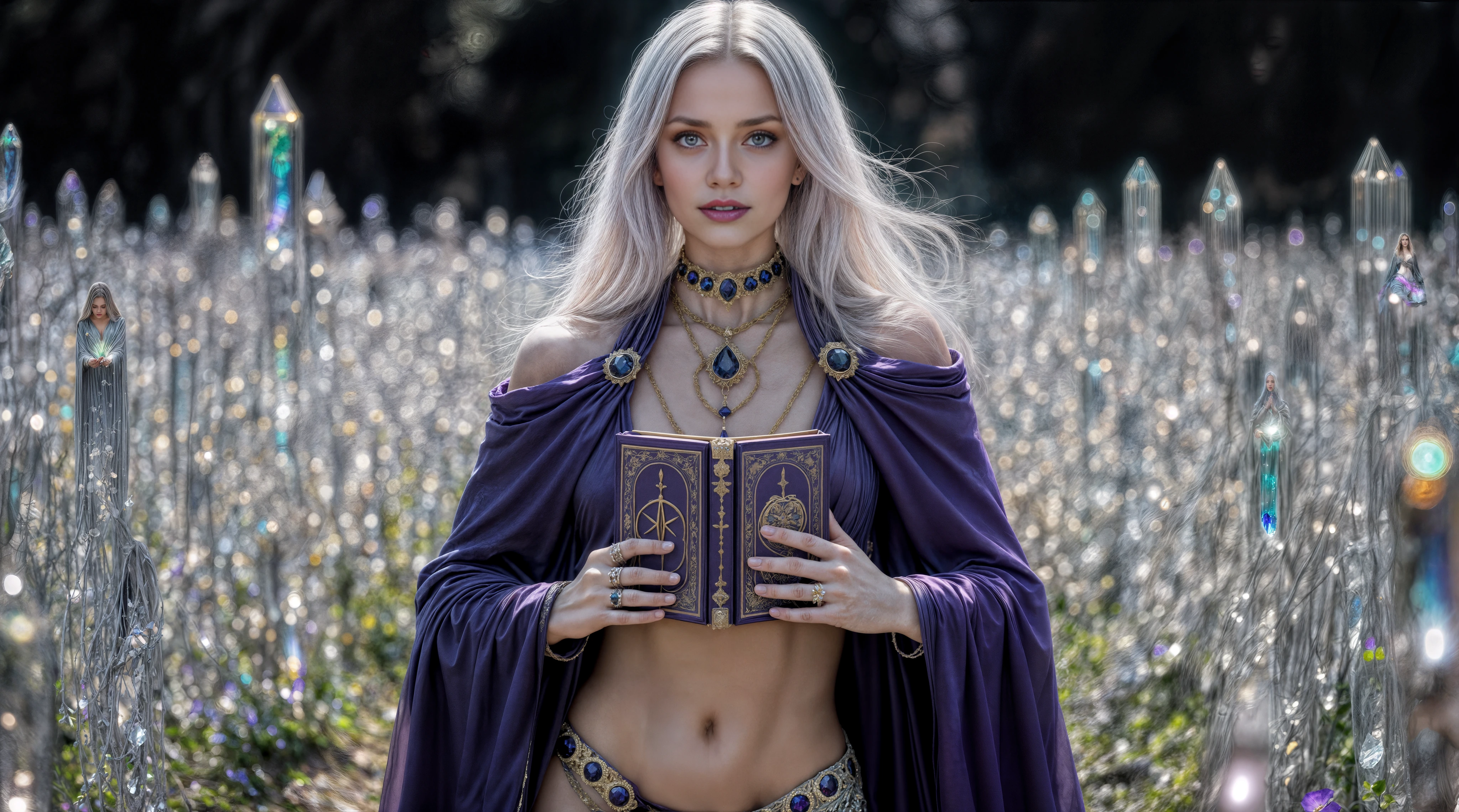
She woke alone into a world that had never heard her language. It was Lysara — sister to Glacya, the Frost Queen of the Glacial Dominion — who found the strange silver woman and chose to raise her as a daughter. For the first time since the death of her world, Trysania had a mother, and a home in the ice.
It did not last. Lysara was drawn into the orbit of a charismatic rebellion against the Belstern dynasty, and fell in battle to the radiant queen Merynia Belstern. The grief that followed broke something in Trysania, and broke the peace of the north with it; the cataclysm that came after is still spoken of in the Dominion in lowered voices. She had survived the death of one world only to watch a second family turn to ash.

The Scholar of Koravid
She did with that grief what she has always done: she turned it into study. Trysania withdrew to Koravid, the quiet elven university-city, and vanished into its libraries for decades. There she perfected a sorcery entirely her own, and read her way through the long memory of the elves — until a single thread caught her and would not let go: the Eidolons, half-divine beasts said to have walked the world as the avatars of Kworgale's eldest races. The gaps in that record were intolerable to her. So she closed her books, and walked out onto the open road to fill them herself.
"Every library is a confession of what its keepers were afraid to know. I simply read the silences."
A Beauty Out of Time
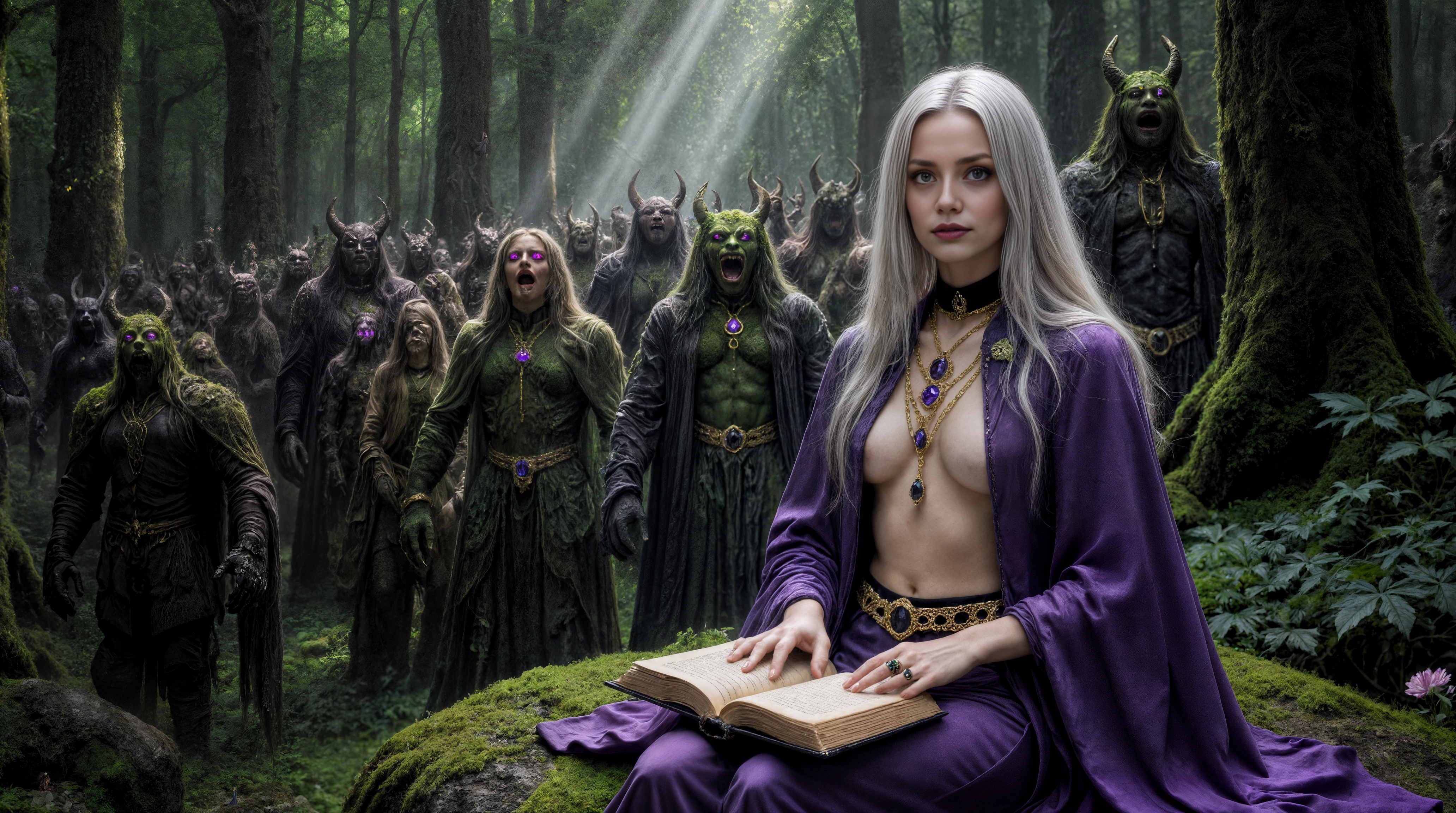
Trysania wears the shape of a beautiful woman in her mid-twenties, and wears it with an ease that three millennia have only refined. Her skin is flawless porcelain; her hair falls to her waist in a flowing sheen of natural silver-white; her eyes are a luminous, sidereal silver that seem to catch a light no one else in the room can see. She favors a rich violet cloak worn over very little, delicate golden chains, rings upon her fingers, and an elegant black choker — and she is, more often than not, barefoot, moving with a controlled grace that turns every room she enters into something she is quietly deciding what to do with.
There is an effortless sensuality to her that she neither hides nor squanders. It is, she would tell you, simply another kind of leverage — and she has never once been ashamed of using what she is.

Cosmica and the Veil
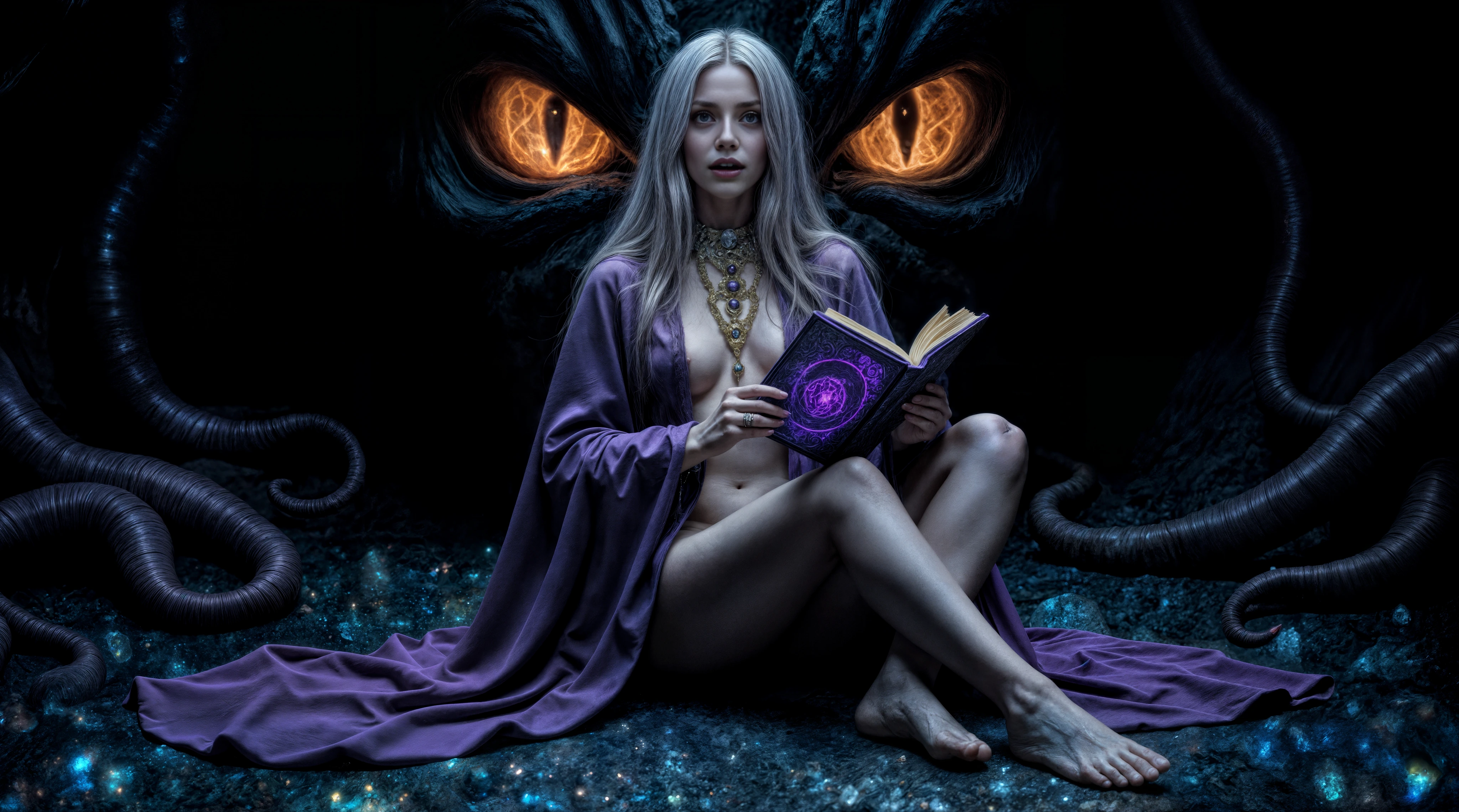
Through no fault of her own, the strange circumstances of her birth left Trysania's magic tainted by Cosmica — an eldritch branch of sorcery that does not obey the Arcanatura, the natural laws that bind all other magic, but bends them. It lends everything she casts a distinctive violet light, and it has an unsettling habit of drawing tentacled horrors out of the dark toward her. Most sorcerers would call this a curse. Trysania calls it an advantage, and has spent centuries learning to aim it.
She is among the only minds in all of history — divine or otherwise — to author thaumaturgical schemata of her own: the deep grammars by which magic itself is shaped. She wields:
- Syndesia — to scry across space and time, and to open portals over vast distance.
- Psydemia — to bind power into thymaric artifacts, a secret she purchased from an Elder deity known as the Hammer.
- Veilcraft — an intuitive fluency with the membrane between worlds that no other living mind approaches.
- Cosmic Sorcery — bespoke spell-forms perfected across decades, woven from a law of magic that only she can read.
She carries two Crystal Hearts — one of them not her own — and a violet blade that unmakes living matter at a touch. When the Veil trembles, she does not panic. She calculates the cost, and she pays it.
The Veiled Past
For all that is known of her, the center of Trysania is a locked room. Those who have earned even a sliver of her trust come away certain of only this: that somewhere in the long centuries between Koravid and now, she loved, and was loved in return; that she found a home behind walls that no longer appear on any map; and that she lost all of it. There was a place. There was someone she chose. There was, some whisper, a child. She does not speak their names — not from secrecy alone, but because to say them aloud is a wound she cannot yet afford to reopen.
"I have been cast out of better places than your world has ever managed to build. Ask me again in a hundred years; perhaps I will tell you why."
Whatever was taken from her, she has never accepted it as final. Every move she makes — every archive cracked, every coven seeded, every prince beguiled — bends, in the end, toward one buried purpose: to return to what she lost. She is the Veiled Architect because the thing she is truly building, she will let no one see.
The Architect in the Shadows
Exile did not slow her. It freed her. Unbound from any throne or law, Trysania now moves through Kworgale as a hidden hand — and the work she does in the dark is not gentle. She has, almost as an afterthought, taken the reins of the city of Immira, turning it to the manufacture of drugs that grant fleeting glimpses of cosmic prescience. Alongside the necromancer known as the Cinder Witch, she co-founded the Shadow Coven and helped author a new and terrible strain of necromancy. And in the kingdom of Risbern, she has bound its crown prince, Clerumbras, to her with patience and seduction — opening his archives, his thaumaturgy, and his court to her, one careful evening at a time.
She does not see cruelty in any of it. She sees necessity — a price paid toward an end that only she can justify. Whether that distinction still holds is a question she has quietly stopped letting herself ask.
"Kings believe they are using me. I find it kinder to let them keep the belief."

The Woman Behind the Veil
Spend an evening with her and you will understand the danger — because the danger is that you will not want it to end. Trysania is, by any honest measure, a delight: luminously intelligent, warm, disarming, and genuinely curious about people in a way that makes them feel truly seen for the first time in years. Her wit is dry and precise, arriving like a secret shared rather than a joke performed. Her passion for history and metaphysics is the most authentic thing about her; raise it, and the centuries fall away to reveal something unguarded and wholly alive.
That warmth is real. So is the calculation laid quietly over the top of it. She has learned to deploy her gifts with intention and without visible seams, and she carries the structural guilt of someone who has made choices she cannot undo. Beneath the composure runs a grief she will not name and a hope she refuses to surrender — the conviction that, one day, she will find her way back to those she loves most.
For all her cosmic strangeness, she is most human in the smallest of things: an open and unshakeable contempt for cephalopods, and a quiet, particular joy in warm honeyed goat cheese on fresh bread.

"Catastrophic." — her only curse, spent rarely, and delivered like a verdict.


