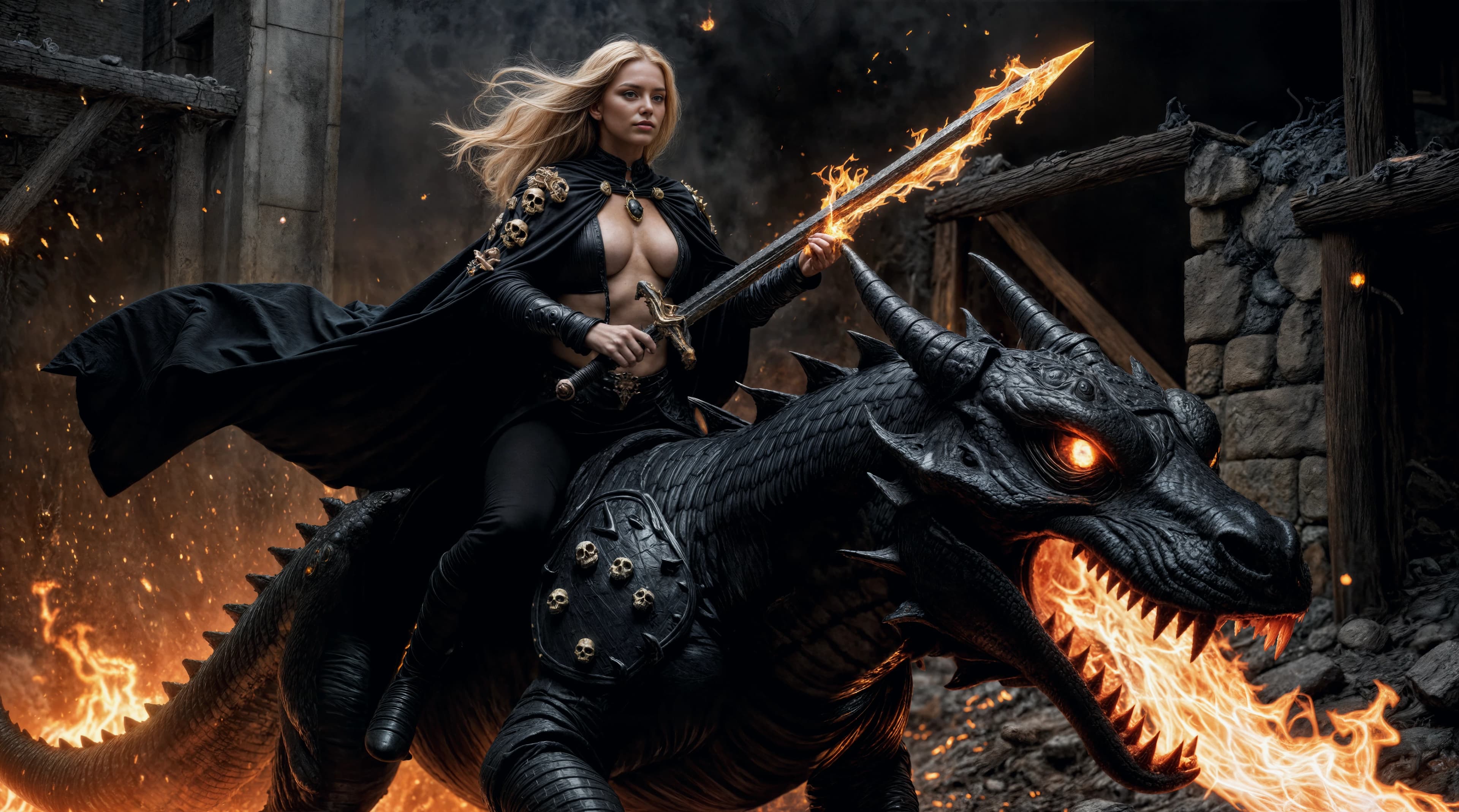


The Mistress of Smoke
Among the banners of the Infernate, none is feared quite like the Twin-Fanged Sigil — a serpent coiled about a burning sword, its fangs poised in both directions. It is the mark of Rysalia: High Commander of the Infernate's armies, the Mistress of Smoke, the Ghost of Fire, the Chosen of the Ashen Serpent — the woman who taught a continent that conviction can cut deeper than any blade.
She commands from Kharbeta, the black ziggurat-city on the ashen plains, and stands second only to her father in the whole apparatus of the Infernate of the Creed. Her office is a military one. That is a technicality: no rite of consequence is performed in Creedal territory without her blessing upon it, and everyone from her own Debt Halls to the ivory galleries of Merynon understands the arrangement perfectly.
To her devotees she is living proof of everything the Creed promises; to the free cities of Kworgale she is the shadow that swallowed the Jewel of the North. She is brilliant, beautiful, and utterly without doubt — and that certainty is the most dangerous thing about her.
"A shark? Oh, darling — you have no idea."
Sister to Flame, Bound to Conviction
Rysalia was born in 1315 DS, the younger of two daughters of Kris — the zealot who forged the Infernate, crowned himself Herald of the Ancient Devil, and rules it still as Grand Hierophant from Merynon.
Their mother was no mortal woman. She was a shard of the Ruby, an avatar the Elder wore for a single decade to found a line and then let go of: she bore Salyria in 1309, Rysalia six years after, and dissipated in 1318. What she left behind was blood. Both sisters are Klerokoi, and their inheritance runs through Klerosia, the kindred flame — which means they do not merely resemble one another in power. They draw on one shared reservoir of thymara, a single pool with two claimants standing at opposite ends of the world. Whatever either of them spends, the other feels go missing.
Alongside Salyria she learned the doctrines of the Creed. Where Salyria came to question them and at last reject them, Rysalia remained — not from blindness, and not from fear, but because she believed. When her sister ran, she begged Rysalia to run with her, and Rysalia refused. She has never described that night as an abandonment. She describes it as the morning she woke up, and she took the credo cut over the halls of Kharbeta as her own private law: do what thou wilt.
She does not hate her sister. Salyria is Flamekeeper of the Emberguard now and turns that order's whole strength against the Creed; their powers are evenly matched, their clashes frequent, and somewhere beneath the smoke Rysalia still mourns the bond they shared. To her, though, Salyria embodies everything that must be undone — balance over dominance, restraint over appetite, mercy over might. Theirs is the only war of the age fought out of a shared purse.

A Beauty Wrought in Ash
Rysalia is deceptively small — five feet three and a half, lithe and hard-trained, with the coiled economy of a duelist and none of a duelist's restraint. The comparison is not decoration. She is an experienced duelist in fact, and has walked away from every single combat she has stood.
Her hair falls in long loose waves of lustrous gold; her eyes are a piercing, wicked azure that miss nothing — not the flutter of a pulse, not the dilation of a frightened gaze. Her skin is fair as porcelain, and she wears it like armor. She favors spare black leathers cut to leave a great deal of her bare, or black robes worked with the skull-sigils of the Creed, and she has never in her life dressed to be overlooked.
Her truest mark is not cloth. Seared into her flesh in the hour of her union is a living serpent of black ink — the brand of her pact, which never holds still. Coiled across her back in one breath, it creeps unseen across hip and shoulder in the next; a dark shadow forever slithering just beneath her own gaze. It is beautiful. It is hers. And it is never, ever asleep.

The Pact of the Ashen Serpent
The Ashen Serpent was not hers to begin with. It was the Creed that found it, recovered out of the deep workings beneath Celasor — a primordial demigod whose true name has been lost to the ages, last and greatest remnant of a race of lizardfolk that died out long before the Creed was ever dreamed. No creature of Demon Fire, but something older: a thing that had survived alone in the dark across uncounted millennia, waiting.
In 1333 DS Rysalia bound it to herself. What she made was a thymaric union — a joining of two souls who are not equals, in which the dominant party may reach into the subordinate and spend what is held there. She is the dominant party. The Serpent's strength stands on call to her as surely as her own, and the increase was so violent and so obvious that the hierarchy of the Creed rearranged itself around her. That same year she took Kharbeta.
Now the god-beast's opal-pale coils answer her like a hound to a whistle, curling around her in a wall of rippling scale, and she rides it into battle as easily as breathing. She is no vessel of Demon Fire. She is a mistress of fire and smoke — and it is the smoke that is underestimated, right up until the moment it is in the lungs.

Around the Serpent's Crown, the black ziggurat she took for her seat, the air has not behaved since. Smoke moves against the wind. Coils that are not present appear along the terraces and are gone again. Ash climbs in slow spirals where nothing is burning.

The Smoke and the Blade
Rysalia's command of the thaumaturgical arts is matched only by her genius for war. Her gifts include:
- Serpent Incarnation — she can partially transform into a coiling ashen serpent of smoke and fire, slithering through shadow to strike with ethereal venom.
- Smokebind — she commands black smoke to cloud battlefields, drown her enemies in illusion, and bind Radiant or elemental magic.
- Scorchbrand — fire magic woven with serpent runes, creating branded glyphs that detonate when struck by flame.
- Shadowflame Projection — searing tendrils of black fire that twist midair to strike from impossible angles.
- Whispers of the Coil — summoned serpent-fragments, spectral and willful, sent to strike, to scout, or to corrupt.
- Serpent Dominion — sight through smoke and shadow, letting her find hidden foes and strike where they believe themselves safe.
Above all she is a strategist — a mind that reads a battlefield the way she reads a frightened courtier, hunting for the flaw in the rhythm. She has never once had to choose between cunning and force; she wields both as a single weapon.
Three things stand behind her, and the world outside the desert has a bad habit of confusing them. The Serpent's Debt is her cult, a subcult of the Creed grown up around her person. The Serpent's Coil is her inner circle, the small handful of advisors she genuinely listens to. The Legion of Ash is her army — a private host of zealots sworn to Rysalia herself and to no other authority in the Infernate.
The Legion is why she is dangerous in a way rank alone does not explain. Its members pledge through Umbrasia, the devotion: a follower gives up a portion of their own thymara, permanently and without remedy, and the leader they have chosen may draw upon it at will. The pledge is recorded in the Pledge Halls like any other debt in that city, and it does not lapse — not with distance, not with years, not with regret. Only the reach lapses. So long as her sworn stand near enough to be commanded, she fights with thousands of souls stacked behind her own.
She spent most of 1336 before the walls of Vallaris, until a summons out of the east pulled her away and Valens Ultor took her place at the siege lines.

The Conqueror of Eisvelde
When her father revived a legendary lost queen — Merynia, the Blue Rose — and bound her fractured radiance to the Creed's will, it was to Rysalia that the living weapon was entrusted.
In the horror-city of Skaitos, in the Citadel of Sorrow, she struck a bargain with the necromancer Alysira, the Cinder Witch, and won the service of the Witch's risen dead — though the price named for them has not yet come due. She has always been comfortable with an account that falls due later.
Her target was Eisvelde: the great northern port, the Jewel of the North, wealthy and commercially confident and governed by merchants who believed that treaties and trade had made them safe. They had dealt for years with Flammund — the Creed's origin city, autonomous and courteous — and read that courtesy as a restraint upon the Infernate entire.
The force that answered was assembled for one purpose out of the most disciplined and ruthless killers the Infernate could supply, sharpened with sorcery and held back until the hour. It was not a raid, and it was not a border campaign. In the first quarter of 1338 DS it came down on Eisvelde in a single lightning assault, and the city was taken in a night of fire that the bards still recount in hushed voices.
More than one city fell with it. The landlocked Creed woke with a deep-water port and the sea in front of it. The eastern third of the continent lost its principal supply of gold — not ornament but strategic material — and the price of arcane work rose in every hall east of the desert. Better than nine parts in ten of all overland trade across Kworgalya came under Infernate leverage. An entire alliance of Risbern broke in a night.
Before Eisvelde, the Infernate could be dismissed as a desert theocracy with unpleasant customs. After Eisvelde, nobody dismissed anything.

"I was a goddess of death, and they were my sacrifices."
Architect of an Empire
Triumph never made her idle. With Eisvelde taken, Rysalia built the landlocked Creed its first fleet, and crossed half the world to win the loyalty of the artificer Vivira — a chaotic genius who forges soul-bound starsteel constructs, and the one soul Rysalia treats with open, exasperated tenderness.
"Up, you mad little genius — before I decide you'd make better ballast in the cargo hold."
Then she did what no commander had done in a thousand years: she sailed past the very edge of the known world to rediscover the lost continent of Thirvandor, and landed her host in its ancient forests to run her enemies to ground and seize the prize hidden there. A Legion. Constructs. Risen knights. A god-beast made her creature. It was not an army; it was a procession of nightmares — and she marched at its head, certain, smiling, and entirely in her element.
She did not build the city she rules. Her father raised Kharbeta out of a dead giant-capital and ran it through handpicked lieutenants for four decades before she set foot in the Serpent's Crown — the Debt Halls, the registries, the arbitration courts, the beautifully documented machinery by which a pilgrim arrives with coin and ambition and departs as property. Rysalia inherited that machine in working order, and within a few years the old reliefs had been chiselled from its walls and replaced with serpents.
Her standing war runs north-east into Risbern, seat of the Belstern dynasty and heartland of the Radiant Light. It is not merely territorial. In the Creed's sacred history the Ancient Deity betrayed her sister, crippled her, sealed her away, then ruled a thousand years over the peoples she had orphaned — so the march east is preached as vengeance, liberation and correction at once, which is more than most commanders can offer a hungry army. The east is worth having on plainer merits too: farmland, forest, freshwater lakes, food growing in ground nobody had to fight for. To soldiers raised on rationed water that tastes of the rock it came through, the eastern plain does not look prosperous. It looks indecent.

What happens next is a tale for another telling.
The Woman Behind the Banner
Strip away the titles, and Rysalia is gloriously, dangerously shameless. She wants power, and she is honest about it in a way that unnerves the pious — pragmatic enough to ally with anyone or anything, vivacious enough to take genuine, almost manic joy in her victories, whether won on the field or in the bedchamber. Seduction, to her, is simply another instrument of statecraft, and she plays it without apology: pansexual, dominant by nature, and unbothered by the rare strong soul who can make her want to kneel. She likes what she likes, and makes no excuses for any of it.
"Winning is making you forget your own name — until the only name you can remember is mine."

Yet she is not made only of confidence. Beneath the predator's smile lie wounds she would never name aloud: a father whose love always arrived with a price, and the buried cost of the pact that gave her everything.
She is most human in the small things — and the smallest of them is fruit. Rysalia is devoted to fresh peaches, properly ripe, heavy and running with juice, eaten over a basin because she flatly refuses to be careful about it. In a black city on the ashen plains, where the water tastes of stone and the reliable food is cavern fungus, a bowl of good peaches must be carried an enormous distance by people who know exactly what happens if the fruit arrives bruised. Kharbeta records every debt in writing; its mistress keeps a standing account in stone fruit.
The same softness runs through the rest of it: a fierce, unglamorous loyalty to the few she truly claims as her own, and the way her certainty goes quiet on the rare occasion she meets a power greater than her own.

The Twin-Fanged Sigil
Rysalia's banner is a serpent coiled around a burning sword, its fangs poised in both directions — the standard of her elite Ashen Serpent Vanguard, sworn to her alone. It holds her two truths:
- The blade — fire as power and action.
- The serpent — shadow as knowledge and control.
It flies silver-white on deep red above the Serpent's Crown, and it has been cut into a great many walls that used to carry somebody else's history. Kharbeta keeps meticulous records of everything. This is the only one of them that requires no reading.
"This snake has not forgotten how to bite."