← All Races
The Elves
The Elves
In the icebound north of Kworgalya, where the evergreen forests give way to glaciers and the night burns with shifting auroras, stand the cities of pale stone and living ice. Their builders are the Pavanar — the elves, the Warden's children, the people of memory and balance. They are tall and fine-boned, ageless and severe, and they do not forget. Where other peoples raise temples to gods half-remembered, the elves raise halls to the dead, and they fill them with light.
Remember, the Pavanar say, and keep the balance.
Children of the Renewal
Like all the Elekoi — the mortal peoples of humans, elves, and dwarves — the elves descend from the Elehath, the feather-winged celestials who fled a dying world beyond the stars and came to young Kworgale in great crystal ships. The elves tell this with less grief than the humans and less pride than the dwarves: it is simply the first thing remembered, the root from which the rest grows. In the Great Renewal, some two thousand years ago, the Elehath laid down their immortal pasts and were reborn as mortals, that they might begin again clean. Five among them did not diminish, and became the Elders.
For five centuries the reborn peoples lived together in Vadesh, the Ur-City. Then came the Fivefold Fleets, the great seaborne dispersal across the continent. The Pavanar turned their prows toward the cold northeast and did not stop until the warm coasts were far behind them — for the Warden, their patron, had taught them that clarity is easiest where the world is still, and nothing is stiller than a land of ice.
The Glacial North
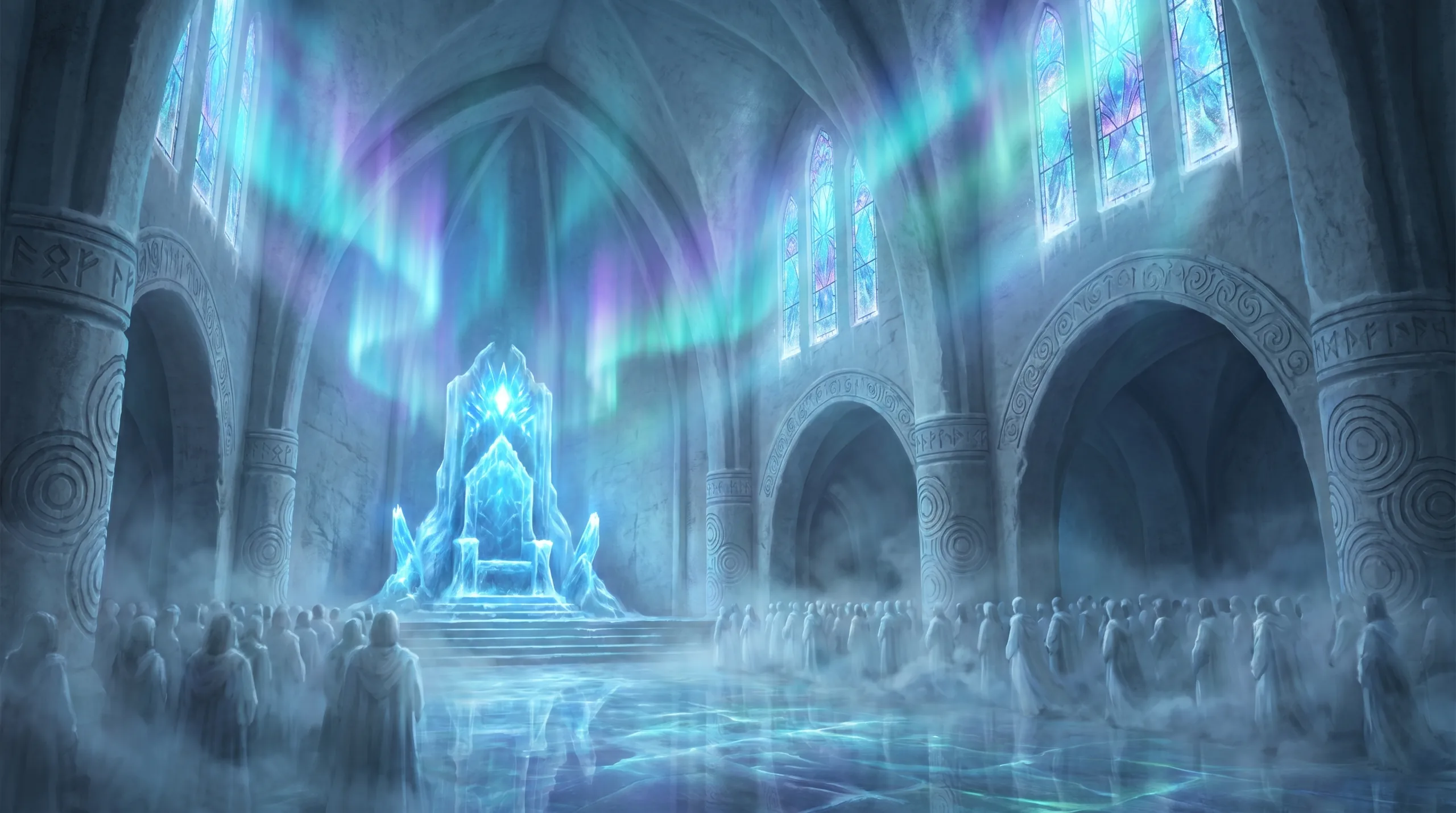
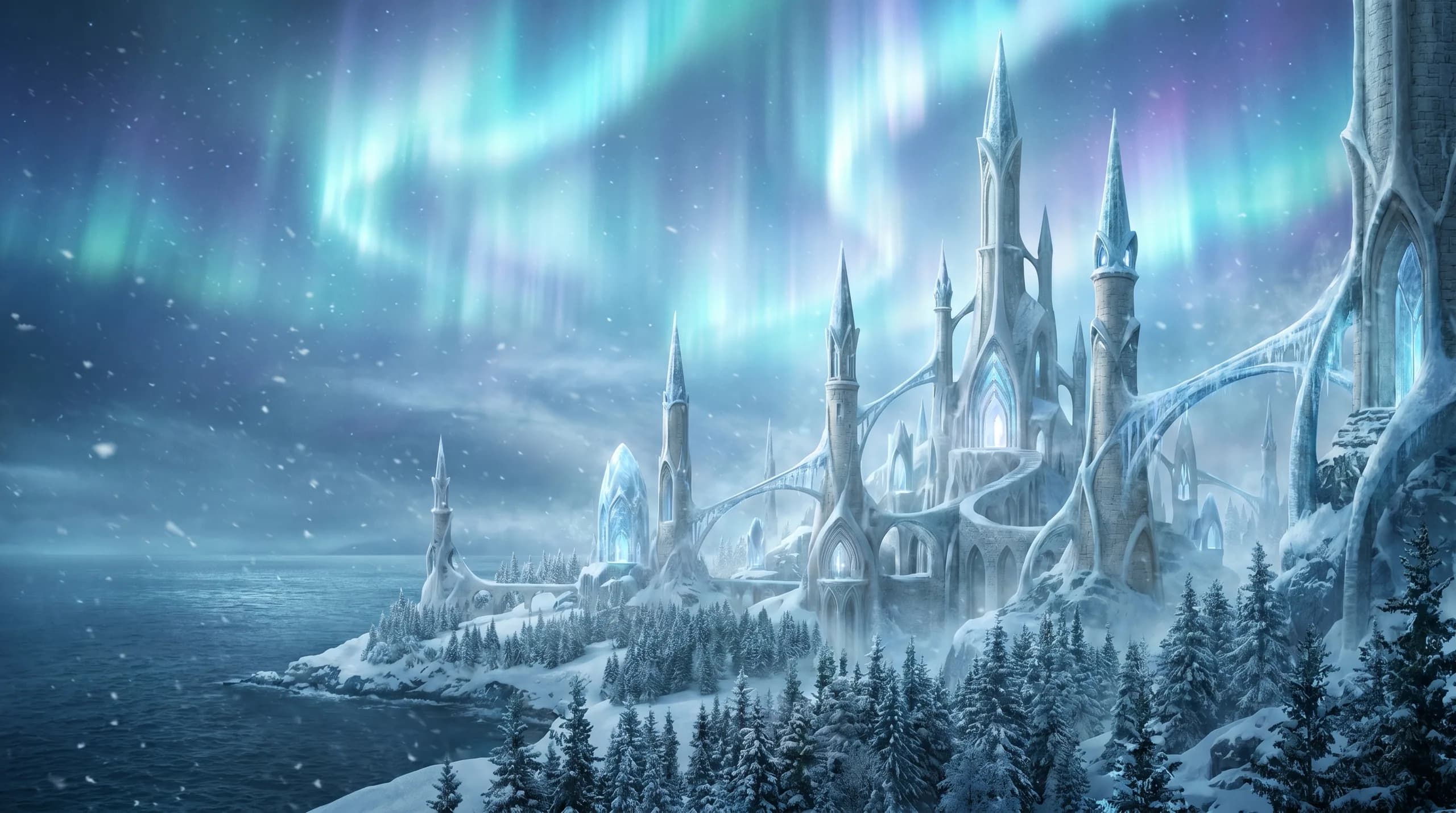
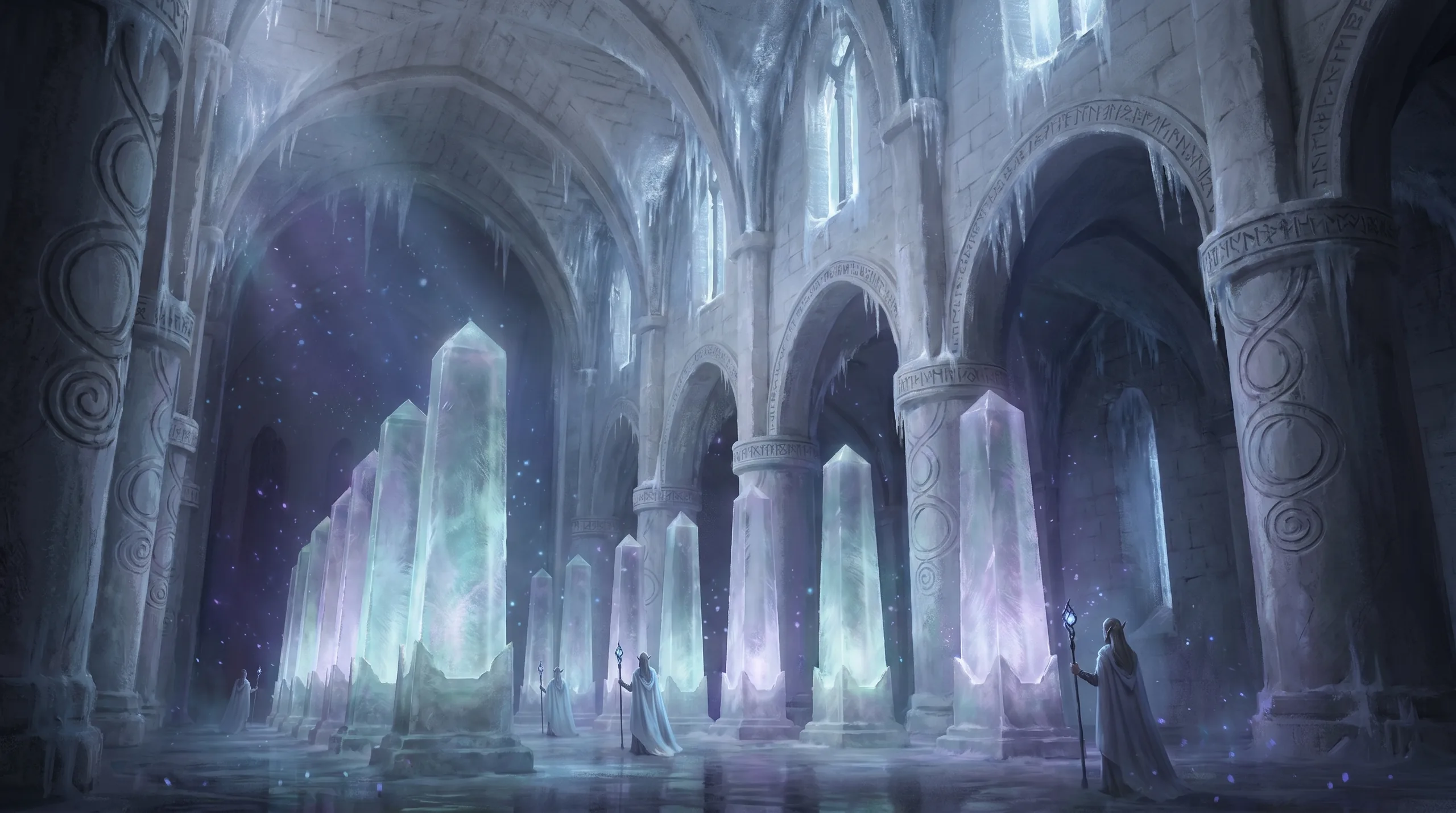
The elven realm climbs from temperate northeastern shore to a frozen, icebound heart — and that heart is the Glacial Dominion, ruled today by their living sovereign. Its capital is Evaskara, city of frost-glass bridges and crystalline spires, where memory-halls glow softly through the long winter dark. At its summit stands the Iridescent Throne, carved of clear blue ice beneath the aurora, and upon it sits Glacya, the Frost Queen — an Elehath of ice and the Dominion's sovereign. Unlike the human south, which is ruled by faith and the memory of gods, the elves are ruled by a queen they can see.
An elf is tall and slender, pale-haired — white-silver is most common, the Warden's white — with luminous eyes whose colour follows the temper of the soul behind them. For every elf is born attuned to one of two primordial tempers. Those born to fire run warm-eyed, amber and gold; those born to ice run cold-eyed, blue and violet. A single bloodline may hold both, and often does, for the elves marry across the divide on purpose. To hold fire and ice within one people, in balance, is their oldest ideal.
One people, two fires, runs an old Evaskaran saying. Let neither consume the other.
The Memordia
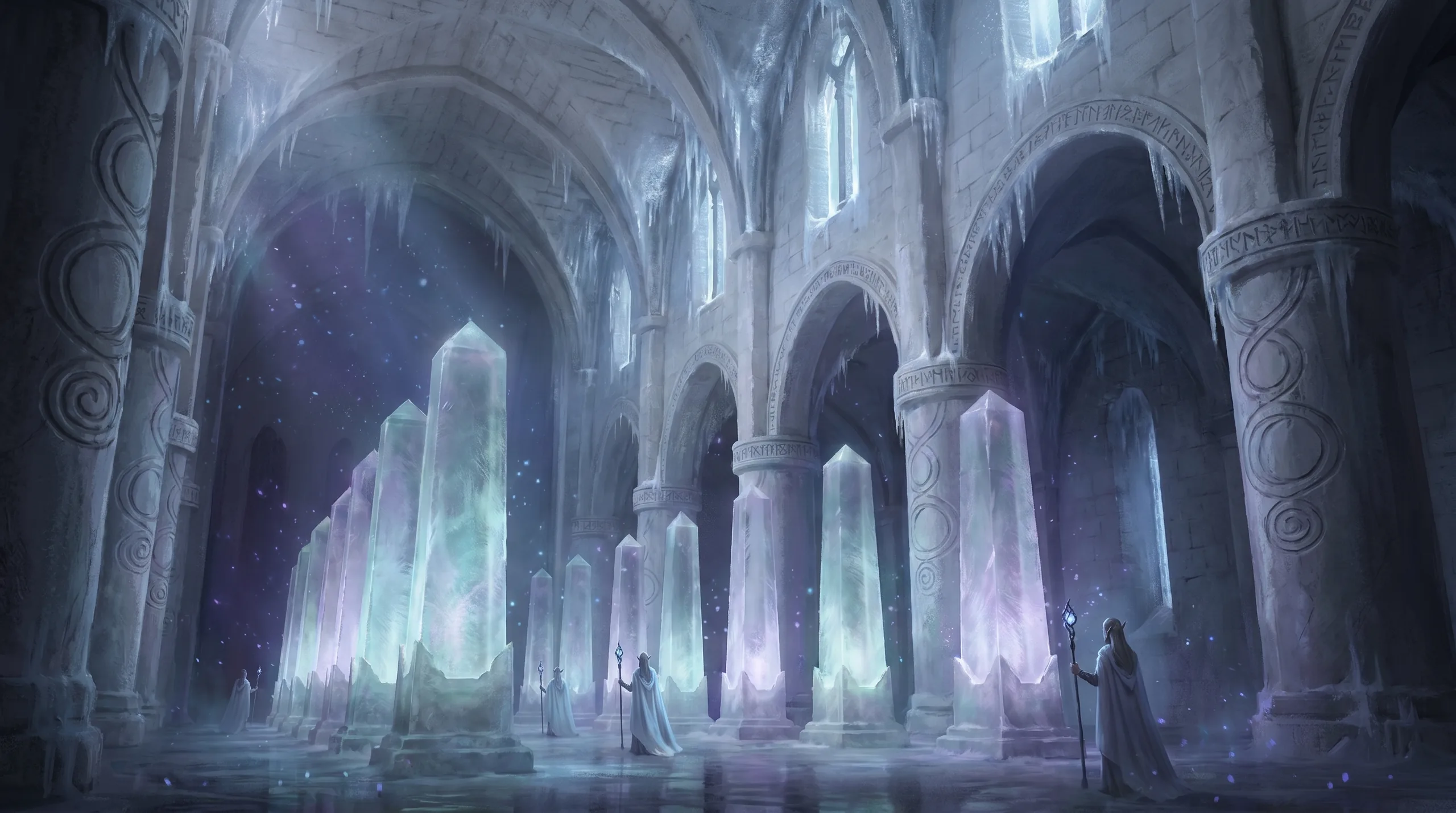
The Warden gave the elves the Memordia, the schema of crystal-memory: the art by which the minds and memories of the dead are gathered and preserved in living crystal, so that what a soul knew is not lost when the soul departs. This is the holiest work the Pavanar know. Their memory-halls are vast cathedrals of glowing plinths, each a life kept against forgetting, and the keepers who tend them — robed in white, moving in reverent silence — hold an office older and graver than any priesthood.
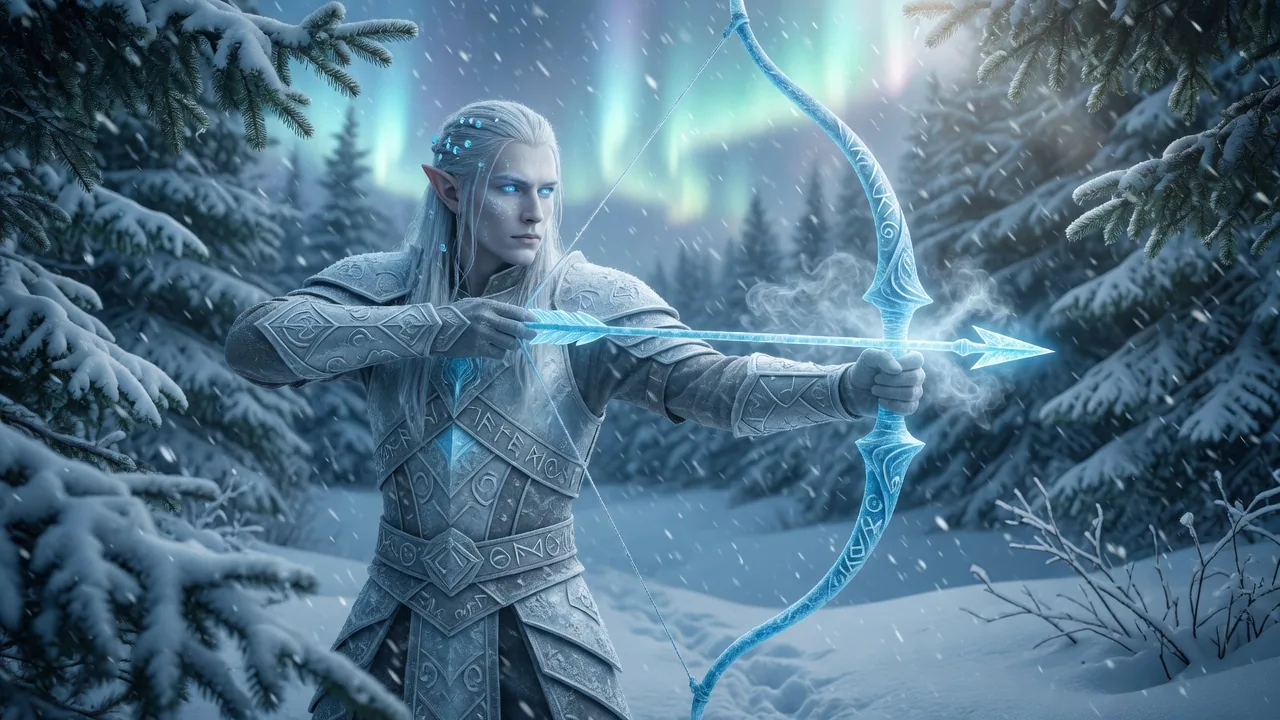
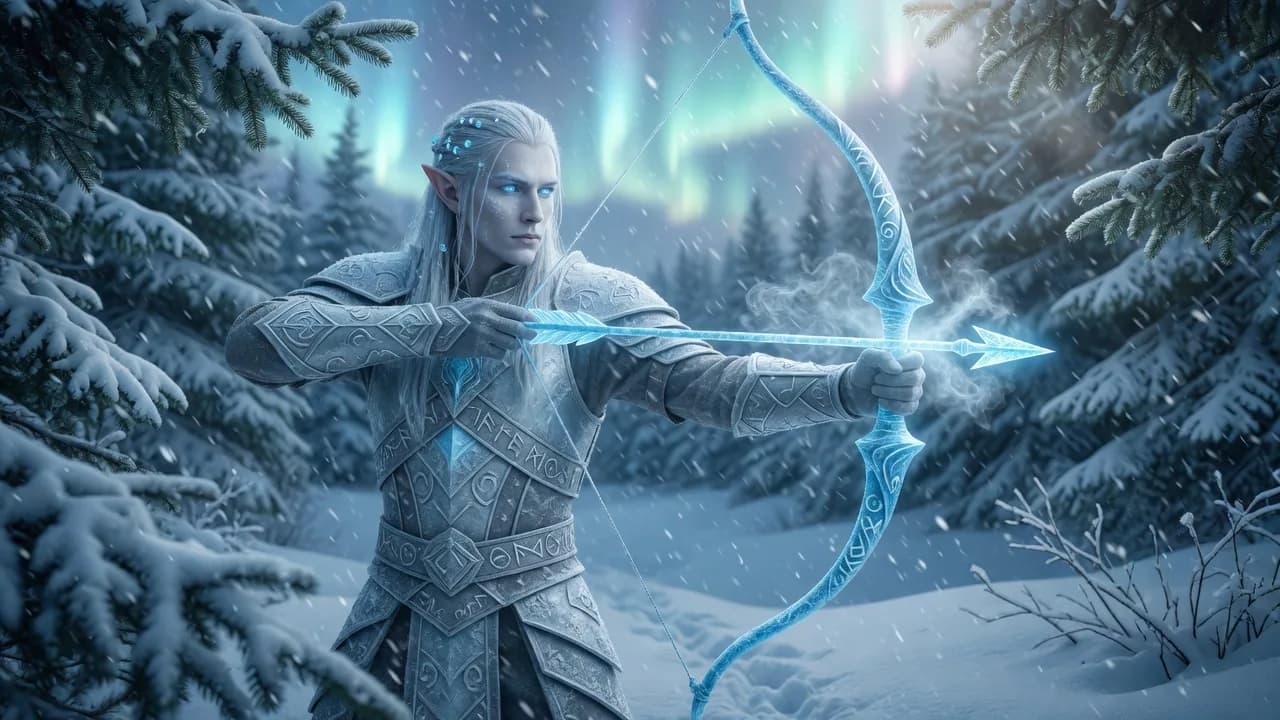
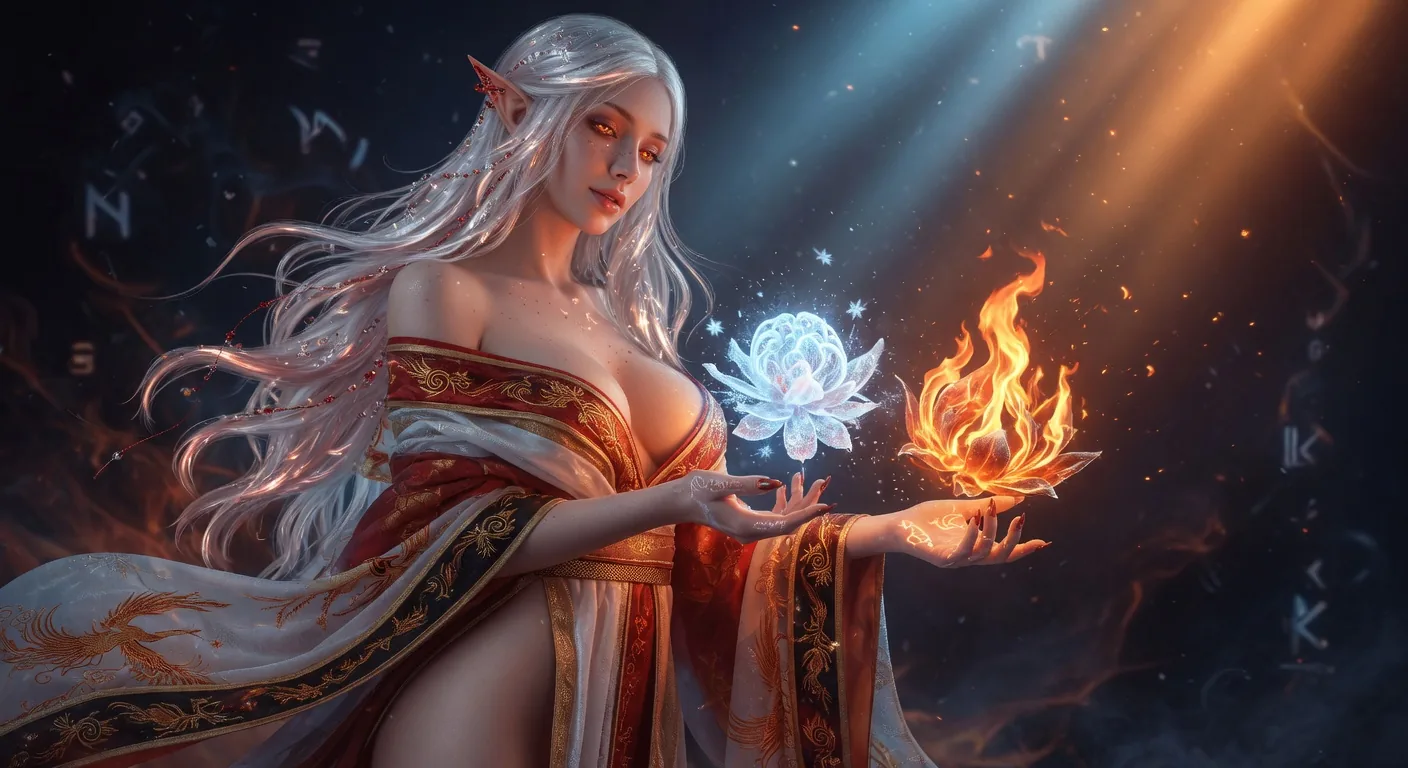
All elven sorcery flows from the Warden's teaching of the natural laws — the patient discipline by which thymara, the force generated by sapient minds, may be shaped without violence to the world's order. An elf does not bend the world so much as ask it, patiently, in its own language. A fire-attuned elf coaxes ember and warmth; an ice-attuned elf calls frost and the killing cold; and the rarest and most honoured can hold a bloom of flame in one hand and a bloom of frost in the other and let neither win. The elven frost-rangers of the deep woods carry bows and blades of living ice, and they are reckoned the most patient killers on the continent.
Memory in Place of Worship
This is the strangeness the southern peoples never quite forgive: the elves do not, by and large, pray. Their grandparents saw the Elders walk the earth; they fought beside them in the crusades against the Beasts and mourned them after the great fall. To the human south the Elders are gods, vast and veiled. To the elf they are forebears — magnificent, terrible, but knowable, the way a famous ancestor is knowable. And so the Pavanar are a secular and philosophical people, given to debate and patience and long memory rather than to faith. What they hold sacred is not a deity but a discipline: remembrance. To remember rightly, to keep the record clear, to let nothing true be lost — this is, for an elf, very near to a religion.
They are slow to anger and slower to forgive, for a people who live four or five centuries forgets nothing and has all the time in the world to settle a debt. They are scholars, archivists, lawgivers, and astronomers, and they regard the brief, blazing lives of their human cousins with a tenderness that can curdle, in the worst of them, into condescension.
The fire-folk burn bright and brief, the Pavanar say. We keep the embers of everyone.
The Balance Kept
A thousand years and more have passed since the Conflagration broke the Elders and the Deity's Sacrifice closed it. The world is still rebuilding from that fall, and the elves — patient, ageless, ruled by a queen of ice beneath an aurora that never quite goes out — keep their long vigil in the north. They remember what came before. They hold their two fires in balance. And in their crystal halls the dead are not silent, only waiting to be heard.