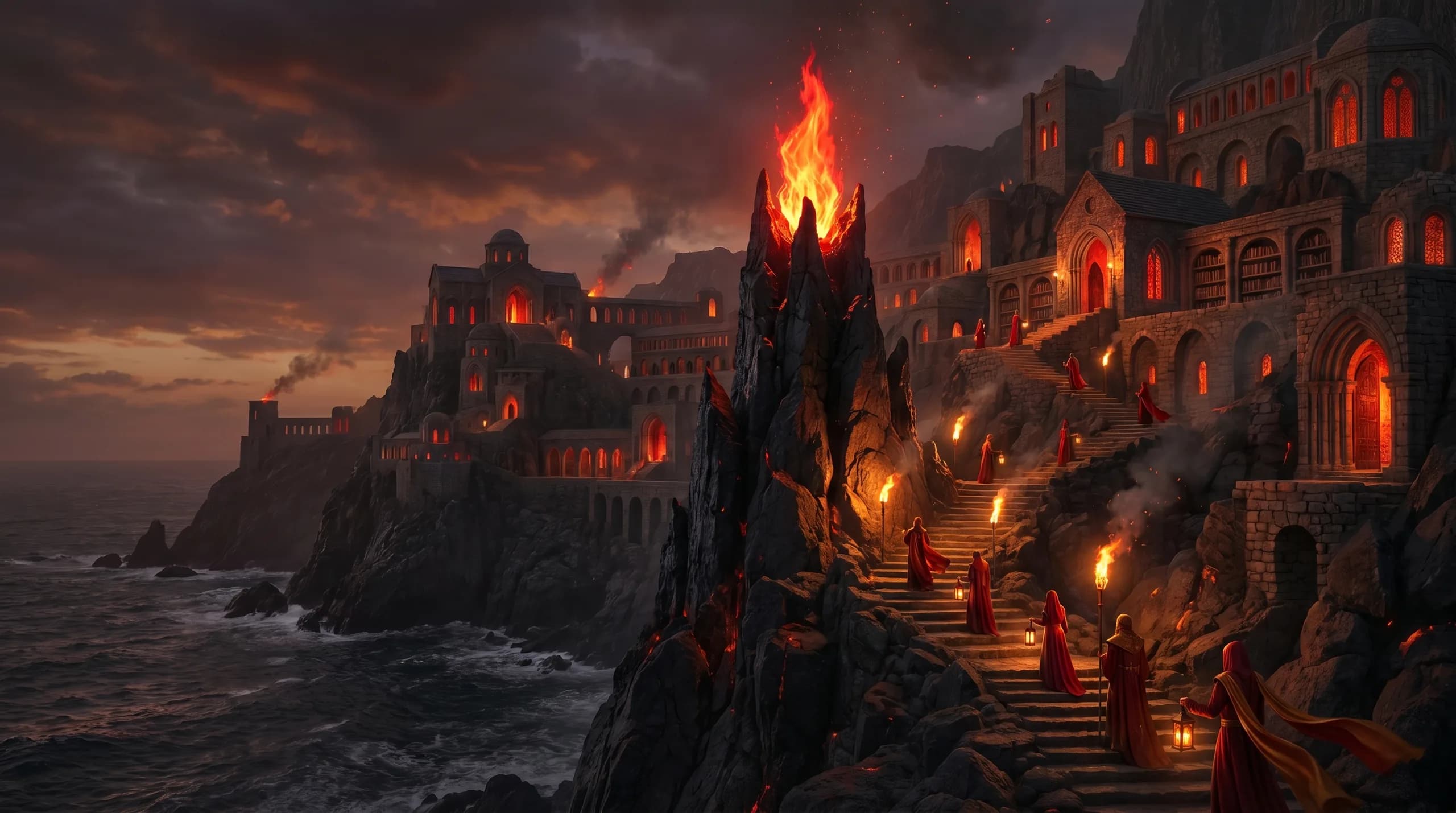
The Ruby is the most beloved and most feared of the gods of the human south — and of all the divine powers of Kworgale, she alone is worshipped not as a distant maker but as a living, burning presence. To her faithful she is the goddess of fire, freedom, family, and beauty, the creator of humankind, the warmth at the heart of every hearth and the spark behind every act of defiant self-rule. Hers is the official faith of the great Daskilon confederacy, and her sacred flame has not been allowed to go out in over two thousand years.
Twenty-nine charted cities keep her, more than any other faith the Atlas records — and unlike the religions that rose after the gods fell, hers never had to be founded.
"Daskilon is the steel. Velastra is the mind and the flame."
One Goddess, Six Faces
The genius of the Ruby's faith is that it is one religion worn six different ways. The Ruby is a single goddess, but she is venerated through six aspects — six faces of the same divine fire — and each great city of the south lifts up the face that suits its own soul. To the scholar she is the patroness of knowledge; to the soldier, the keeper of courage; to the farmer, the giver of the harvest; to the freebooter, the breaker of chains; to the horse-lord, the queen of joy. The fire that fills a library lamp and the fire that razes a wicked city are, the priestesses teach, the same fire — only asked for different things.
No city wears its face for long without becoming it. Tirbasos forges weapons and keeps the Scorchmother, and its temple's talk of purifying flame is not a figure its foundries strain to hear; Karnosta keeps the Freebride and never troubled itself with law, which is exactly why its priestesses ended up being the law. A traveller who knows a city's face knows in advance what it will forgive, and the priestesses have never denied it. They teach it to merchants.
Her clergy are, without exception, women. The priesthood of the Ruby is the oldest and most powerful sisterhood in the human world, and in the cities most devoted to her their word outweighs that of any magistrate or guild.
The High Pyreia and the Seat at Velastra
Above all the priestesses of all the cities stands a single figure: the High Pyreia, supreme head of the entire cult, who governs the faith from the cliff-city of Velastra — "First Light of the Ruby," the oldest human city in the world and the spiritual heart of the south. Velastra is the one place where all six faces of the Ruby keep formal temples, and the Pyreia rules from the greatest of them, the temple of the Thoughtmaiden. There the doctrine is written, the rituals are standardized, and the daughters of the powerful are sent to be made into priestesses and battle-sorceresses both. By ancient custom the ruling lord of Daskilon sends his eldest daughter to be raised in Velastra's temple — a living bridge binding the sword of the realm and the faith of the Ruby into a single hand.
Beneath the Pyreia each temple governs its own house and answers for its own city's face. What Velastra supplies is not command but standard: the wording of the rites, the training of the women who perform them, and the ruling that settles what two temples cannot. A priestess is at once the keeper of her city's fire, the teacher of its children, the court of last resort, and the registrar of its bloodlines — and the last of those is why she is feared. The Ruby's gift to humankind was Klerosia, the kindred flame, in which a family's strength is pooled and inherited down the line, so a marriage in the south is not an arrangement between two houses but the joining of two reservoirs of power. The woman who keeps that register holds one end of every dynasty in the human world.
"A daughter sent to Velastra is never truly lost, for she returns as fire."
The Fire That Is Carried
No rite of the Ruby begins by striking a new flame. Every fire used in her worship is taken from one already burning — the household lamp from the street shrine, the shrine from the temple hearth, the temple hearth from Velastra — and a congregation gathers not to watch a fire made but to watch one handed on. The rites themselves are plain and repetitive by design, because the words are the standard form of the working itself: the opening a mother uses to wake a hearth on a cold morning is the opening a battle-sorceress uses to raise a firestorm, and every child in the south learns it before they learn to read. Around that carried flame a southern life is arranged entire. Births are brought to the fire, marriages made across it, oaths sworn to it — to the last spark — and disputes heard in front of it, where lying is held to be a poor idea.
The Six Faces of the Flame
The Thoughtmaiden — Fire as Knowledge
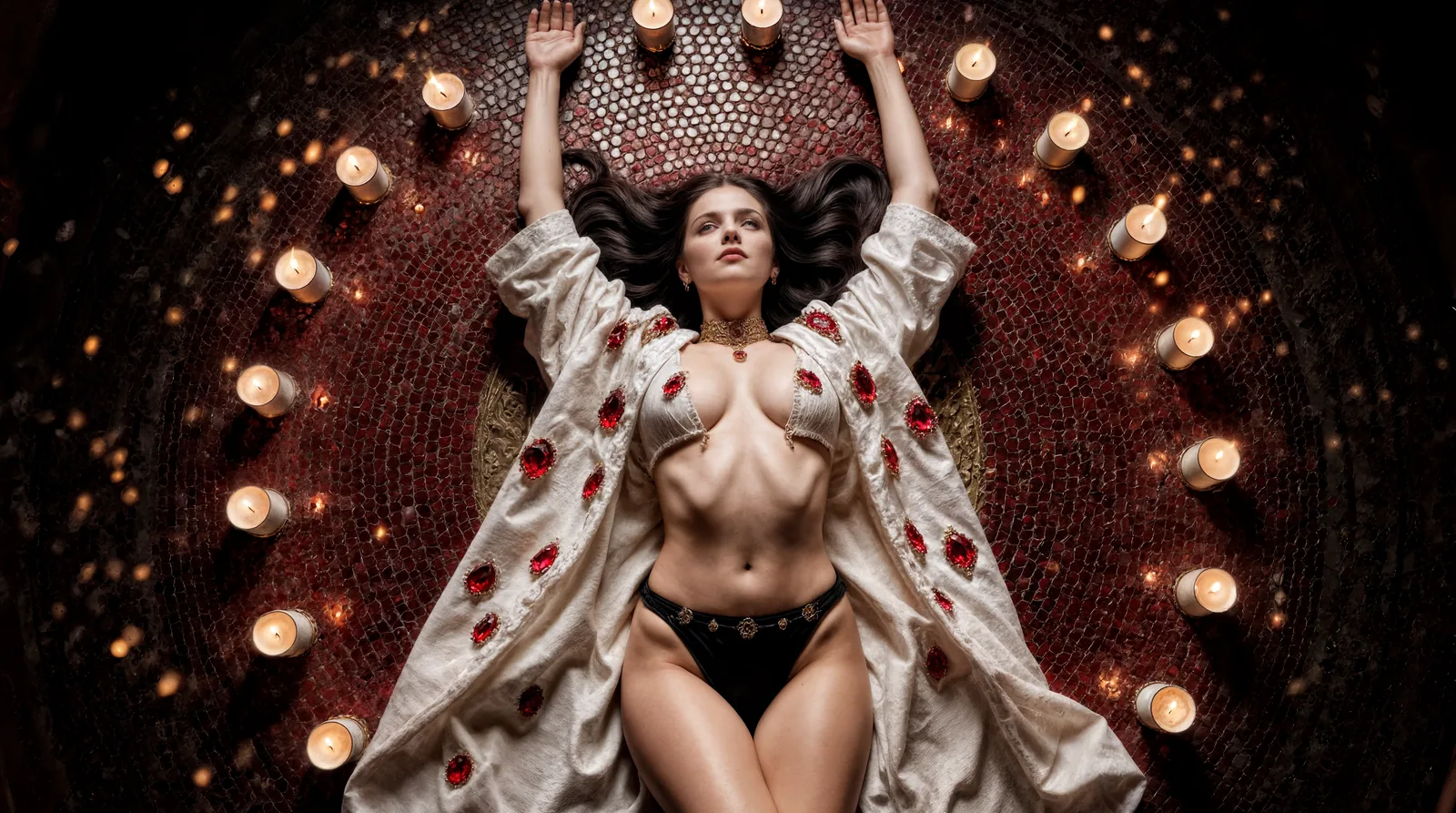
At Velastra, the Ruby is the Thoughtmaiden (Theokora): the patroness of learning, memory, and clarity, in whose name the priestesses keep the largest library in the world and tend the never-dying "fire of illumination." Hers is the city's true heart, and from her temple the High Pyreia governs the whole faith. To serve the Thoughtmaiden is to believe that the brightest flame of all is an enlightened mind.
The Firewife — Fire as Courage

The Firewife (Pyranaika) is fire as warmth and weapon both. At Velastra her temple trains the dreaded battle-sorceresses — battlefield pyromancers and ritual flamekeepers seconded to Daskilon's armies — while in the cold mountain valleys of Navalis she is gentler, the guardian of the hearth, honored at a small fire-altar in nearly every home. To the soldiers of Andronis and Darolas she is the war-bride to whom oaths are sworn "to the last spark."
The Scorchmother — Fire as Judgment and Harvest
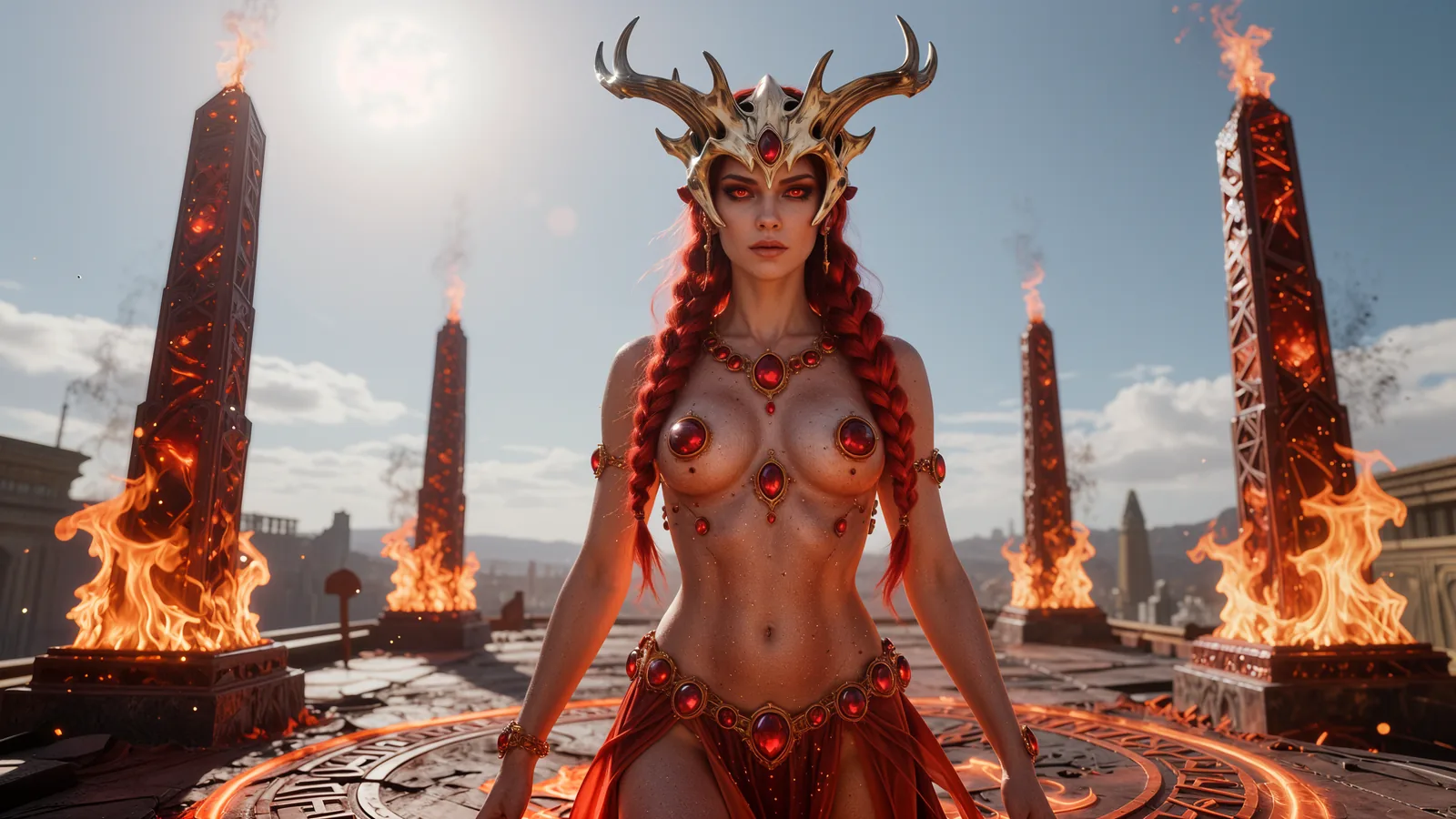
The Scorchmother (Kaumatria) is the most fearsome and the most generous of the faces, depending on where you kneel. In the industrial fortress-city of Tirbasos she is a vengeful goddess of purifying flame and righteous destruction — "a fire that spares the innocent and consumes the wicked is the Scorchmother's smile." But in the green breadbasket of Erothys that same aspect is the gentle patroness of growth and labor, whose priestesses bless the canals and the controlled burns that make the fields fertile again.
Lysanyma, the Freebride — Fire as Freedom
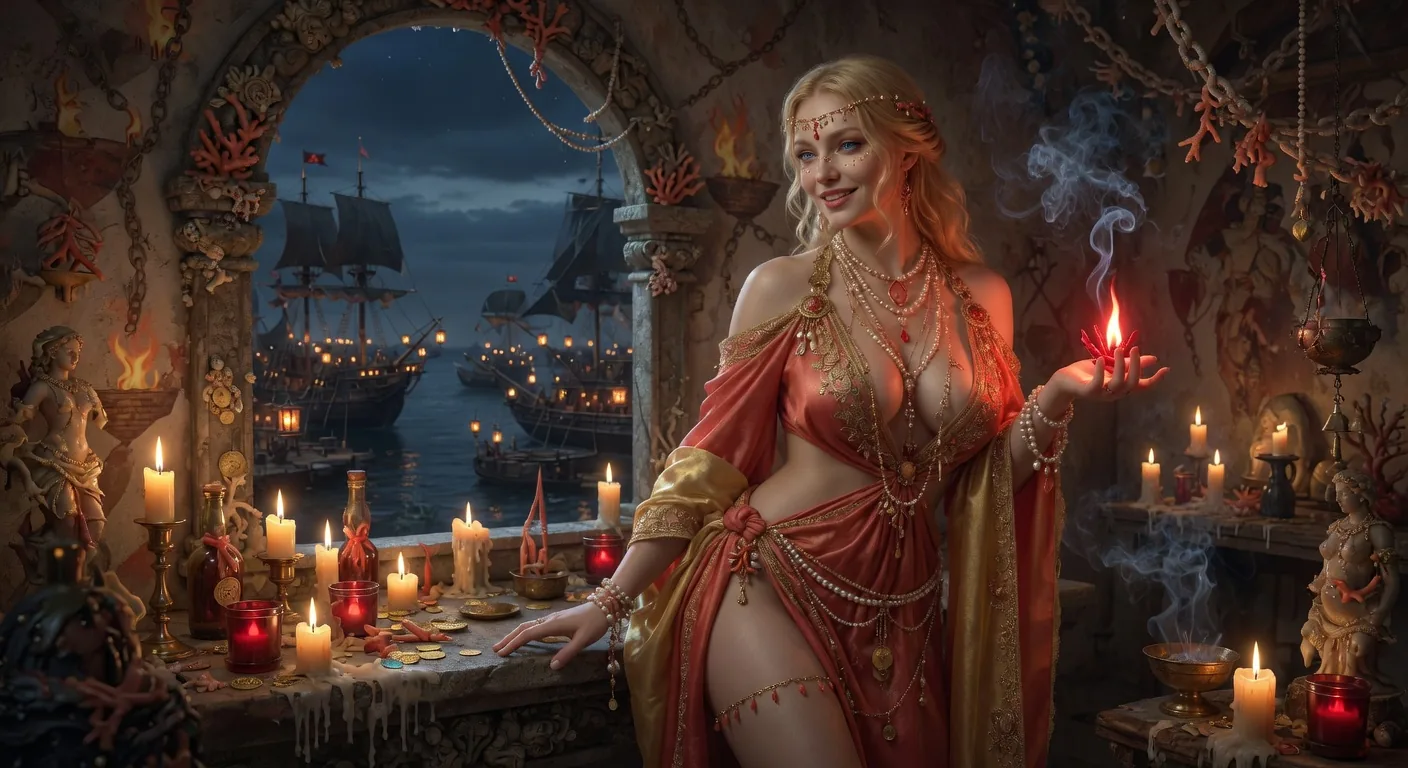
In the pirate haven of Karnosta, the Harbor of Freedom, the Ruby is Lysanyma, the Freebride — a fitting patron for a city that worships liberty and settles the consequences later. Her harbor-temple is famously warm and her priestesses notoriously friendly, yet those same priestesses serve as the city's mediators and informal courts, ending feuds with brokered compromise and holy theater both. A quarrel in Karnosta can be won by a reconciliation public enough, and sacred enough, to put the matter to rest.
Charakyra, the Joyqueen — Fire as Joy
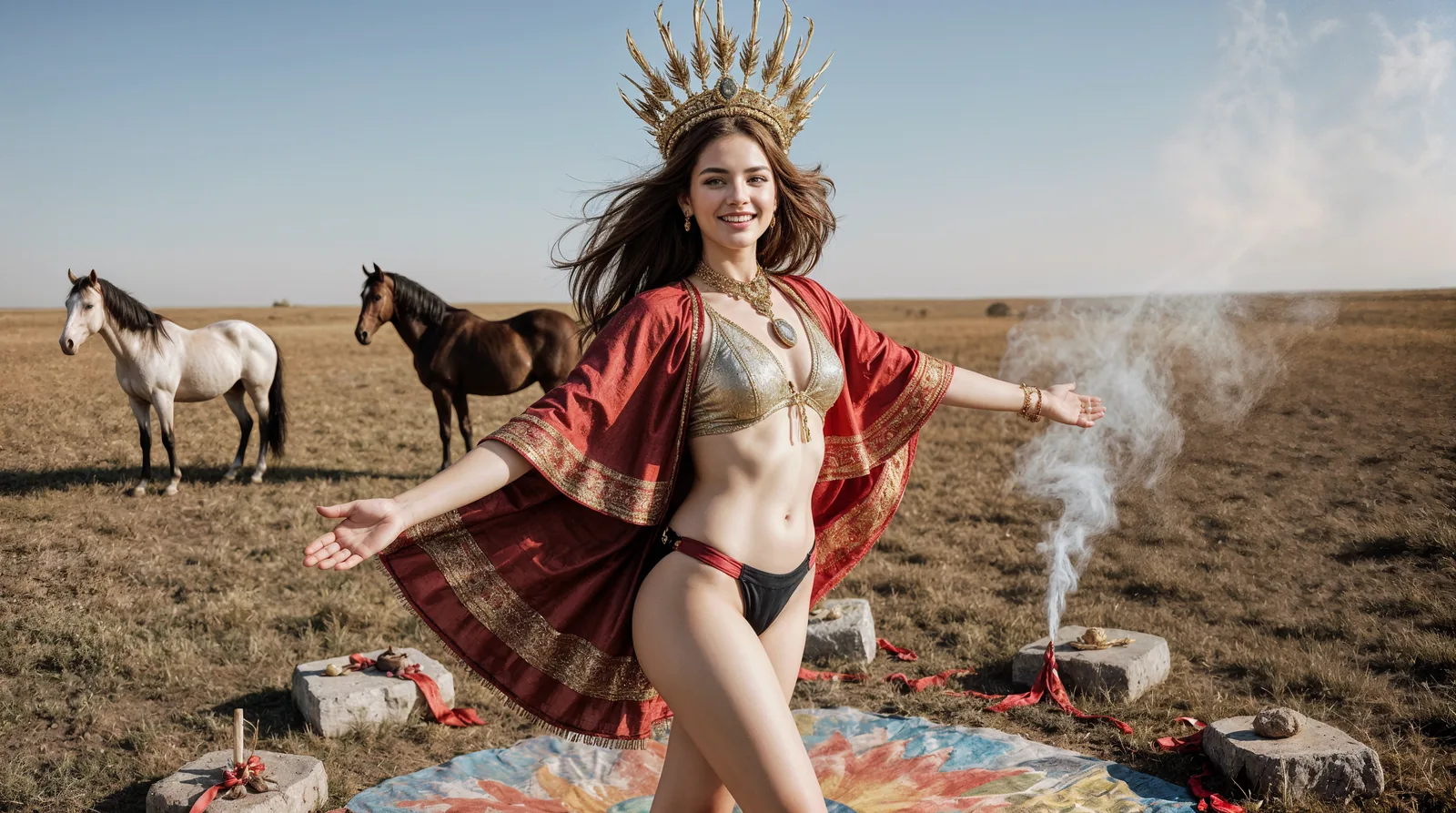
Out on the great plains, the horse-folk of Hipalos venerate the Ruby as Charakyra, the Joyqueen — the aspect of delight and the fierce happiness of being alive. Hers is a faith with no grand temples; to ride at speed across the grass is itself an act of worship. Her shrines are open-air stones hung with ribbons, and her holy days are festivals of racing and mounted archery lit by the great joyfires that blaze whenever a caravan comes or goes. In the music-loving forest town of Drusmere she wears a second name, the Joymaiden, where song itself is devotion.
Pharosina, the Beaconmistress — Fire as Guidance
The sixth face is Pharosina, the Beaconmistress — fire as guidance, discovery, and safe harbor: the lighthouse-flame that calls the lost ship home and the beacon that marks the edge of the known world. The most quietly spoken of the six, she is honored most where the land meets the sea, and her lamps are said to burn for travelers who do not yet know they are being waited for.
Her likeness is kept for a later telling.
The Living Flame
For all its six faces, the faith is finally about one thing: a fire that must never be allowed to die. In every temple of the Ruby burns a flame said to be a borrowed ember of the first flame itself — and the wisest of the priestesses know a secret the pilgrims do not: that the fire they tend is older even than their goddess, drawn from the deep heart of the world where the Great Spirit of Fire still burns. The Ruby is the face the faithful can love and the name they can pray to; but behind her, and behind every flame ever lit in her temples, is something far older, and far stranger, that the Ruby herself once reached down and befriended.
The priesthood does not hide what follows from that. Fire was never the Ruby's to give; it belongs to nobody, and a sorcerer who raises one is borrowing from something vastly larger that is already in pain and cannot refuse him. The temple flame does the opposite — carried, tended, passed along, and asking nothing of her at all. So the answer taught at Velastra to the obvious question is that the goddess did not give the world fire. She gave humankind the standing to ask for it, and a family to ask with.
So her people keep the fire. They keep it in the library lamp and the war-brazier, the harvest-burn and the harbor-beacon, the joyfire and the hearth — and they trust, as they have for two thousand years, that so long as the flame endures, so will they.
The Argument in Front of the Fire
The hardest thing said about the Ruby is not said by her enemies. She did not make the world; she came into it out of the ruin of another one, with the rest of her kind and a great deal to answer for, and when the others laid down their immortality in the Great Renewal she was among the handful who did not. Her divinity is not a birthright. It is what was left over, and her temples have argued for twenty centuries over what is owed to it. She stayed because someone had to: the merciful founder. She stayed because the fire needed a keeper and nobody else would take the work: the tragic necessity. She stayed because she owed a debt no death would discharge, and every flame is a payment against it. And there is the reading the priestesses will not preach and do not silence — that greatness absolves nothing, and that a power never called to account has merely not been called yet.
The Freebride's daughters end the argument by refusing to end it. A goddess whose whole portfolio is freedom, they say, is the one god alive it would be a heresy not to question.
Six Faces of the Flame
A hymn to the flame in all its faces — the fire that creates, the fire that ruins, and the faith built on both.